
Why teams choose losLab PDF Library
One source-available engine for the whole document pipeline, from generation and conversion to signing, validation, and delivery
One engine, any language
Use the Object Pascal source in Delphi, C++Builder, and Lazarus, or call the same API through DLL, ActiveX, and Dylib builds from C#, VB.NET, VBA, Visual C++, PHP, PowerBuilder, and more
Runs where your code runs
Windows x86, x64, and ARM64, plus native headless builds for Linux and macOS on x64 and ARM64, now including a Delphi Linux64 compiler target
Convert into compliance
ConvertToPDFA, ConvertToPDFX for PDF/X-1a to PDF/X-6, ConvertToPDFE, ConvertToPDFR, and AutoTagPages turn existing files into archival, print, engineering, raster, or tagged documents, each with a report of what changed
Signatures built for the long run
PAdES B-B to B-LTA, native OCSP and LDAP CRL revocation, EU trusted-list checks, historical validation, and post-quantum ML-DSA signatures with the FIPS 204 identifiers alongside Ed25519, Ed448, and SM2
Get content back out
Extract text in reading order to DOCX, JSON, CSV, or Markdown, detect tables, replace Unicode text exactly, and diff whole documents word by word across page boundaries
Gigabyte PDFs, hardware AES
Open files beyond 2 GB on demand, merge lists in one pass with bookmarks, fields, and tags intact, and encrypt multi-gigabyte files file to file with AES-NI acceleration
losLab PDF Library at a glance
| Product | losLab PDF Library (PDF Library for Delphi) — source-level PDF SDK with native, DLL, ActiveX, and Dylib integration |
|---|---|
| Best for | End-to-end PDF automation in one engine, including teams beyond Delphi via DLL and ActiveX |
| Languages | Delphi and C++Builder XE5-13; Free Pascal 3.2.2 / Lazarus on Windows x64 alongside FPC 3.3.1; native Linux and macOS headless builds on x64 / ARM64; Windows ARM64 with FPC 3.3.1 and Delphi ARM64EC; DLL / ActiveX integration for C#, VB.NET, VBA, Visual C++, and compatible callers |
| Rendering | Switchable GDI+, PDFium, and Cairo engines |
| Standards | PDF version controls, PDF/A, PDF/UA-1 and PDF/UA-2 checks, PDF/X-6/p/n and PDF/VT-3 workflows, PAdES, Arlington model checks, and e-invoice XML validation (compliance checks and Arlington require Enterprise; e-invoice validation requires Small Business) |
| Large files | Opens PDFs beyond 2 GB with on-demand loading and direct rewrites |
| Source code | Full Object Pascal source with every source-edition license; the DCU edition ships precompiled binaries |
| Licensing | Royalty-free, one-time $475-$4750 by tier, including the DCU edition; renewal at 50% of list price |
| Current version | 4.68.32 (2026-11-15) |
| Evaluation | Free demo package download |
Source-available PDF engine for developer-owned workflows
losLab PDF Library is a Delphi, C++Builder, and Lazarus PDF SDK for applications that need to create, modify, render, print, sign, secure, inspect, and preflight PDF documents inside their own software.
The library is written in Delphi/Object Pascal and is available with full source for Delphi, C++Builder, and Lazarus projects. It also ships DLL, ActiveX, and Dylib options for teams that need to integrate PDF automation from C#, VB.NET, VB6, VBA, ASP/ASP.NET, PHP, PowerBuilder, PowerBASIC, RealBasic, Visual C++, and other environments that can call a DLL or ActiveX component.
Use it when the PDF workflow is part of your product or back-office process: generated invoices, signed contracts, archive submissions, accessibility review, print output, form processing, document assembly, or CI checks that should fail before a bad PDF reaches customers.
Download PDF Library DEMO package
Current release and recent improvements
Version 4.68.32 (2026-11-15) hardens public-key encryption workflows, cross-platform signature verification, and precise QuadPoints redaction, on the 4.x line that split compliance validation and preflight reports, secure redaction, and e-invoice business-rule validation into the Enterprise edition
- Public-key PDFs in practice: open and resave public-key-encrypted documents whose body and attachments use separate crypt filters and recipient keys, honor named clear filters in revisions R4 through R7 — including mixed AES-CBC and AES-GCM filters in R7 and mixed RC4, AESV2, and Identity filters in R4 — open files that encrypt only embedded files with a matching recipient credential, resolve the permissions shared by all recipients, and report a missing recipient through Direct Access with a PFX credential or the Windows certificate store
- Signature verification without platform stores: pure-Pascal X.509 DER parsing and OCSP evaluation verify EdDSA, ML-DSA, and SM2 signers and reject revoked certificates on non-Windows platforms without platform certificate stores; chain building accepts cryptographically verified legacy issuers without a SubjectKeyIdentifier extension, full UTF-16BE Reason, Location, and ContactInfo strings survive signing, and Ed25519/Ed448 external-digest signers work
- Redaction that covers only what must disappear: appearance repair and ApplyRedactions paint only the QuadPoints sub-regions instead of covering unredacted content across the full bounding Rect, RedactRegion creates a content stream and draws its box in initial user space even on empty pages, and appearance generation decodes UTF-16BE and UTF-8 BOM text while normalizing self-intersecting QuadPoints (Enterprise: secure redaction)
- Stricter PDF/UA language checks: PDF/UA-1 and PDF/UA-2 validation detect malformed BCP 47 language tags consistently while accepting grandfathered and private-use tags, resolve inherited page resources, recognize the owning structure element's language for alternative text, and read escaped literals and BOM-encoded text in inline marked-content language tags
- 64-bit wrappers and everyday reliability: ActiveX and C# wrappers use pointer-sized device-context handles on Win64, the ReportBuilder and QuickReport devices render fill-only shapes and preserve PNG transparency, the viewer's drag modes create ink, square, and circle annotations with the new DrawColor and DrawLineWidth properties, and TIFF strip, JBIG2, EMF, CFF, and ToUnicode edge cases no longer block decoding or saving
See the release notes and API reference for individual changes and platform-specific requirements
Main PDF capabilities
- Create and edit PDF pages: draw text, vector graphics, images, QR codes, PDF417, DataMatrix, barcodes, annotations, links, outlines, named destinations, metadata, and document properties.
- Page assembly and document repair: split, merge, append, copy, clone, normalize, move, delete, hide, rotate, and rebuild pages from controlled source documents.
- Render and print: switch between GDI+, PDFium, and Cairo rendering engines for screen preview, bitmap export, device-context rendering, and printer workflows.
- Forms and interactive documents: create, fill, edit, flatten, inspect, and manage AcroForm fields, appearances, field flags, JavaScript actions, attachments, and related document data.
- Text, images, and fonts: work with BMP, TIFF, JPEG, JPEG 2000, GIF, PNG, EMF, HTML text boxes, Unicode text, TrueType, OpenType, Type 1, font embedding, font subsetting, and extraction workflows.
- Security and signatures: encrypt and decrypt PDFs with hardware AES-NI acceleration on 32-bit and 64-bit Windows, protect or unprotect multi-gigabyte files through direct file-to-file AES-256 paths that never build the full object graph, set permissions, use public-key recipient encryption, sign with selectable SHA-256/384/512 digests, add PAdES attributes, timestamp signatures, and attach DSS/VRI validation data.
- Huge documents: open PDFs beyond 2 GB with on-demand object loading and 64-bit offsets, merge file lists in a single pass with bookmarks, form fields, and Tagged PDF structure trees preserved, append incremental updates to the source file in place, and copy or rewrite million-object documents in seconds through the Direct Access API.
- Structured extraction and exact replacement: extract text in tagged reading order with semantic roles, columns, page furniture, and table cells exported to JSON, CSV, Markdown, or DOCX, replace Unicode content exactly while preserving surrounding characters and spacing, and add OCR text layers through optional Tesseract adapters.
- Visual comparison and invoice validation: compare rendered pages or whole documents with channel tolerance, ignored regions, difference masks, and overlays, and validate embedded e-invoice XML against versioned schemas and Schematron rules through xmllint or SaxonJ. (Small Business feature)
- Preflight reports and diagnostics: run PDF/A, PDF/UA-1, and PDF/UA-2 checks, generate text, JSON, HTML, or CSV reports, compare stable text reports against baselines, batch-process folders with summary CSV output, and audit signature health and document policies at scale with the SigningWorkbench and ComplianceWorkbench demos. (Enterprise feature)
- Low-level PDF control: access object numbers, page dictionaries, catalog entries, output intents, save-version locks, extension-level gates, tiling patterns, optional content, measurement dictionaries, and direct image insertion when your workflow requires precise PDF structure.
Performance evidence: The public PDF Library changelog records dated large-file changes, sample sizes, object counts, and before/after timings. Treat those measurements as reproducible engineering references rather than guarantees for different files or hardware.
Standards and compliance-oriented output
PDF compliance depends on the source content, fonts, ICC profiles, metadata, tagging, alternate text, signatures, timestamps, and the validator used by your organization. losLab PDF Library provides the controls and diagnostics needed to build standards-oriented PDFs, while leaving final policy validation in your application or QA pipeline.
| Workflow | Library support | Application responsibility |
|---|---|---|
| PDF version control | Creation, editing, save-version locks, extension-level checks, rendering, printing, forms, and document structure APIs, including PDF 2.0 profile workflows | Choose the output version and remove or upgrade features outside that profile |
| PDF/A | Output-intent controls, XMP metadata helpers, embedded-font workflows, version guards, and built-in PDF/A file checks for archival pipelines. (File checks require Enterprise) | Provide correct metadata, fonts, color profiles, and business rules for the selected archive policy. |
| PDF/UA-1 | Tagged PDF construction, structure-tree APIs, role-map handling, alternate text, ActualText, reader-side checks, and writer-side GetPDFUADiagnostics feedback. | Author meaningful reading order, language, headings, lists, table semantics, alternate text, and form descriptions. |
| PDF/UA-2 | Reader checks for identification, PDF version, namespaces, role mappings, document roots, and structure parents, with explicit checked and unverified coverage | Review accessibility semantics and requirements outside the implemented checks |
| PDF/X-6 and PDF/VT-3 | PDF/X-6, PDF/X-6p, and PDF/X-6n authoring with output-profile controls; PDF/VT-3 document-part hierarchies and dedicated preflight | Supply production color data, document-part coverage, and the print workflow required by the receiving system |
| Arlington and invoice XML | Arlington model rules report incomplete support explicitly; optional Schema and Schematron providers validate invoice attachments with stage diagnostics (Arlington requires Enterprise; invoice validation requires Small Business) | Select model and invoice-rule versions and configure external validation providers where required |
| PAdES | ETSI.CAdES.detached signatures, signing-certificate-v2 data, signature policy and commitment attributes, RFC 3161 timestamp augmentation, SHA-256/384/512 digest choices, and DSS/VRI assembly. (Timestamp augmentation and DSS/VRI require Enterprise) | Supply certificates, TSA responses, revocation data, signature policy choices, and verifier-specific acceptance testing. |
| Preflight automation | CreatePreflightReportEx, SavePreflightReportEx, and the PreflightReport scenario in ComplianceLab generate text, JSON, HTML, and CSV output for PDF/A and PDF/UA-1 checks. (Enterprise feature) | Decide which report formats, baselines, exit codes, and issue counts should block CI, archive ingestion, or customer delivery. |
| Security | AES-128, AES-256, permission handling, password protection, public-key recipient encryption, and encrypted-document inspection for controlled distribution. (Public-key recipient encryption requires Enterprise) | Keep passwords, certificates, private keys, and recipient policies under your own security controls. |
API surfaces and deployment choices
- Delphi and C++Builder XE5 through 13; Free Pascal / Lazarus on Windows, including FPC 3.2.2 Windows x64 coverage. Native Windows ARM64 requires FPC 3.3.1, and Delphi ARM64EC builds are also supported
- Native headless APIs run on Linux and macOS across x64 and ARM64 for generation, loading, text workflows, Cairo rendering, OpenSSL signing, and time-stamping; Delphi Linux64 compiles with the RAD Studio compiler on the same native backend as the Free Pascal build. Rendering, codecs, cryptography, and XML validators have platform-specific provider requirements
- Native Object Pascal source code for direct Delphi and C++Builder integration, with API reference pages generated for public
TPDFlibfunctions. - DLL and ActiveX access for C#, VB.NET, VB6, VBA, ASP/ASP.NET, PHP, Visual C++, PowerBuilder, PowerBASIC, RealBasic, and compatible tools.
- 32-bit and 64-bit build options where the target IDE and runtime support them.
- macOS Dylib option for teams that need cross-platform PDF automation around the same library family.
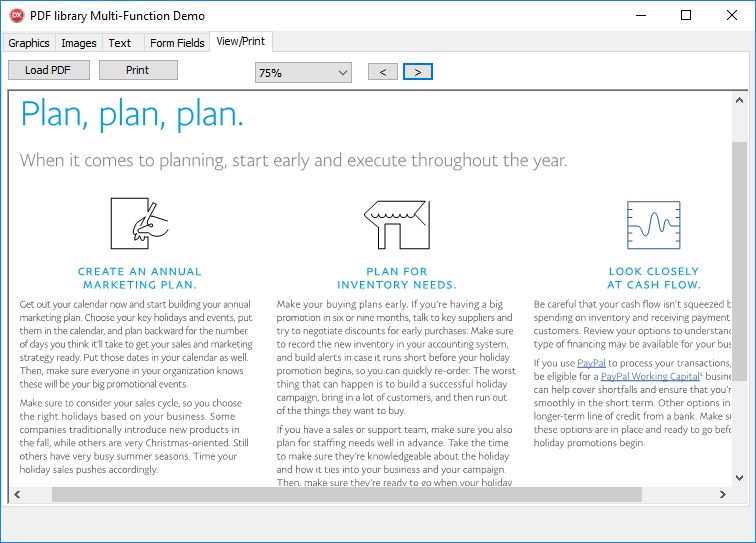
- Standalone demo projects for PDF creation, page operations, image and font handling, forms, encryption, signing, rendering, printing, and preflight report automation.
Quick Delphi example
uses
  PDFlibrary;

procedure CreateHelloPdf;
begin
  with TPDFlib.Create do
    try
      SetOrigin(1);
      AddStandardFont(4);
      SetTextSize(24);
      DrawText(92, 96, 'Hello world from Delphi');
      SetTextSize(11);
      DrawText(94, 126, 'Created with losLab PDF Library.');
      SaveToFile('HelloWorld.pdf');
    finally
      Free;
    end;
end;
The same call pattern extends to page assembly, form filling, encryption, signing, rendering, and preflight reporting; the demo package ships complete projects for each workflow.
Included demos and validation coverage
Delphi, C++Builder, and Lazarus each ship the same example portfolio: a flagship nine-page Showcase, a minimal HelloWorld, and nine self-contained domain labs. Each lab runs its scenarios from one executable; started without arguments it plays a guided quick tour and opens an offline HTML report, while --list and --scenario NAME expose the individual specialist operations.
- GraphicsLab and ImageLab: shapes, patterns, layers, watermarks, and canvas text, plus image import, masks, EMF import, and CCITT, JBIG2, and image-compression matrices.
- ContentLab: font embedding and subsetting, text measurement, wrapped and paged text, HTML text flow, tables, dataset export, barcodes, and report framework adapters.
- DocumentLab and InteractiveLab: page operations, merging, linearization, text and image extraction, attachments, XMP metadata, and
DocumentInspectionWorkbench, alongside form fields, XFA fields, outlines, named destinations, links, and document actions. - ComplianceLab and SecurityLab: PDF/A guard matrices, Tagged PDF, output intents, e-invoices,
PreflightReport, andComplianceWorkbench, plus encryption, permissions, signing, PAdES DSS, signature validation, redaction, and sanitizing. - DeliveryLab and PerformanceLab: rendering to images and metafiles, printing, output streams, parallel rendering, and mail delivery, plus huge-file, merge, and image-decode benchmarks.
- DLL workflow examples: C# and VB.NET
WorkflowWorkbenchprojects and native C++ examples cover report generation, text extraction, page splitting and merging, binary memory transfers, and explicit native resource ownership; Delphi additionally keeps an interactiveReader.
Recent automated coverage includes Delphi DUnitX and C++Builder GoogleTest suites for document creation, compression, images, fonts, forms, security, signing, printing, PDF version compliance, PDF/UA diagnostics, and preflight report generation and comparison.
When to choose losLab PDF Library
- Choose it when your application must create, modify, sign, validate, and deliver PDFs, not only display them.
- Choose it when your Delphi or C++Builder team needs source-level control, internal diagnostics, and long-term maintainability.
- Choose it when your workflow combines rendering, printing, forms, signatures, encryption, PDF/A, PDF/UA, PAdES, and preflight reports in one toolkit.
- Choose it when CI, archive handoff, accessibility review, or regulated delivery needs stable report files instead of a manual viewer-only check.
- Choose this library when DOCX export, switchable GDI+ / PDFium / Cairo rendering, EU trust-list validation, Arlington model checks, or packaged DLL / ActiveX / Dylib APIs match your workflow
- Compare HotPDF for its built-in renderer, dynamic XFA runtime, and HTML/CSS layout; compare PDFium Delphi Component for its viewer, accessible-reader integration, and progressive PDFium workflows
Licensing and pricing
Pay with credit/debit cards, PayPal, AliPay, or wire transfer through 2Checkout / FastSpring -- source-edition tiers list both checkouts, while DCU tiers use FastSpring. Every new source-edition license includes the full Object Pascal source code for Delphi, C++Builder, and Lazarus, one year of updates, and one year of email support.
| License | Developers | Price (one-time) | Order |
|---|---|---|---|
| Single | 1 developer | $950 | Buy PDF Library for Delphi Single |
| Small Business | Up to 5 developers in one company | $2375 | Buy PDF Library for Delphi Small Business |
| Enterprise | All developers in one company | $4750 | Buy PDF Library for Delphi Enterprise |
| DCU Single | 1 developer, precompiled units without source | $475 | Buy PDF Library for Delphi DCU Single |
| DCU Small Business | Up to 5 developers in one company, precompiled units without source | $1187.5 | Buy PDF Library for Delphi DCU Small Business |
| DCU Enterprise | All developers in one company, precompiled units without source | $2375 | Buy PDF Library for Delphi DCU Enterprise |
License choice: Choose Single for one developer, or Small Business for up to 5 developers in the same company. Enterprise covers every developer in one company, with no headcount limit. A DCU edition with precompiled binaries for every supported Delphi and C++Builder version is available for Single, Small Business, and Enterprise at half the source price.
Small Business and Enterprise features: PDF Library for Delphi Small Business adds document comparison with revision analysis, e-invoice business-rule validation, Bates numbering and PDF/VCR variable data merge; Enterprise is the complete edition, with every feature including all Small Business features, and adds PAdES long-term validation, HSM and cloud signing, signature validation with EU Trusted Lists, compliance validation and preflight reports, secure redaction and certificate-based encryption, plus priority email support. See the edition feature lists.
Purchase yearly renewal (50% of the current list price).
Comparing the whole family? See the PDF developer libraries overview for a side-by-side of PDFium Delphi Component, losLab PDF Library, and HotPDF Delphi Component.
Frequently asked questions
How is losLab PDF Library different from HotPDF Delphi Component?
Both libraries create, edit, render, sign, encrypt, and validate PDFs. losLab PDF Library offers switchable GDI+ / PDFium / Cairo backends, structured DOCX export, EU trust-list and Arlington tools, and packaged DLL / ActiveX / Dylib APIs. HotPDF combines a built-in renderer with a dynamic XFA scripting runtime and native HTML/CSS layout. Choose by API, document workflow, and deployment requirements
Can I use losLab PDF Library from C#, VB.NET, or other non-Delphi environments?
Yes. Besides native Object Pascal source for Delphi and C++Builder, the library ships DLL and ActiveX builds usable from C#, VB.NET, VB6, VBA, ASP/ASP.NET, PHP, PowerBuilder, PowerBASIC, RealBasic, Visual C++, and other environments that can call a DLL or ActiveX component, plus a macOS Dylib option.
Which Delphi and C++Builder versions are supported?
Delphi and C++Builder XE5 through 13. Free Pascal 3.2.2 supports the Windows x64 library and Lazarus demos alongside FPC 3.3.1; native Windows ARM64 requires FPC 3.3.1, with Delphi ARM64EC also supported. Native headless builds cover Linux and macOS on x64 and ARM64
Which rendering engines does the library provide?
You can switch between GDI+, PDFium, and Cairo rendering engines for screen preview, bitmap export, device-context rendering, and printer workflows.
Does losLab PDF Library support digital signatures and PAdES?
Yes. It creates ETSI.CAdES.detached signatures with signing-certificate-v2 data, signature policy and commitment attributes, RFC 3161 timestamp augmentation, selectable SHA-256, SHA-384, or SHA-512 digests, and DSS/VRI validation data for long-term validation.
How does the library handle very large PDF files?
It opens PDFs beyond 2 GB with on-demand object loading and 64-bit offsets, merges file lists in a single pass while preserving bookmarks, form fields, and Tagged PDF structure, appends incremental updates in place, and copies or rewrites million-object documents in seconds through the Direct Access API.
Can it check PDF/A and PDF/UA compliance automatically?
Yes. Built-in PDF/A, PDF/UA-1, and PDF/UA-2 checks generate text, JSON, HTML, or CSV reports, compare stable text reports against baselines, batch-process folders with summary CSV output, and expose writer-side diagnostics through GetPDFUADiagnostics.
What does a license include, and how does renewal work?
A new license ($950 Single, $2375 Small Business (up to 5 developers), $4750 Enterprise (all developers in one company)) includes full source code for Delphi and C++Builder, one year of updates, and one year of email support. Existing customers renew update access at 50% of the current list price.
Discover more from Delphi PDF Component & Spreadsheet Development
Subscribe to product updates
Subscribe to get the latest updates sent to your email.