
HotPDF Delphi Component At a glance
| Product | HotPDF Delphi Component |
|---|---|
| Best for | Developer-owned document workflows in Delphi and C++Builder |
| IDE support | Delphi and C++Builder XE5 through 13 Florence; Free Pascal 3.2.2 / Lazarus (Win32, Win64) |
| Deployment | Native Windows application integration |
| Source code | Object Pascal source code included with commercial licences |
| Licensing | Royalty-free application deployment |
| Updates | One year of updates and email support included |
| Pricing | One-time developer-count licensing |
| Documentation | HotPDF Delphi Component |
Native PDF creation and editing for Delphi and C++Builder
HotPDF is a source-level Delphi and C++Builder PDF component for applications that need to create, edit, secure, sign, validate, and assemble PDF documents directly from VCL code. It does not require an external PDF runtime for its core authoring workflow and is designed for Windows desktop software built with RAD Studio.
Use HotPDF when your application needs programmatic page drawing, Unicode text output, font embedding and subsetting, forms, annotations, image import, PDF merge/edit operations, encryption, digital signatures, standards-aware output, and lightweight preflight automation from one native API surface.
HotPDF supports RAD Studio XE5 through RAD Studio 13.1 Florence for Delphi and C++Builder, including Win32, Win64, and Win64x workflows, and builds with Free Pascal 3.2.2 and Lazarus for Win32 and Win64.
Main capabilities
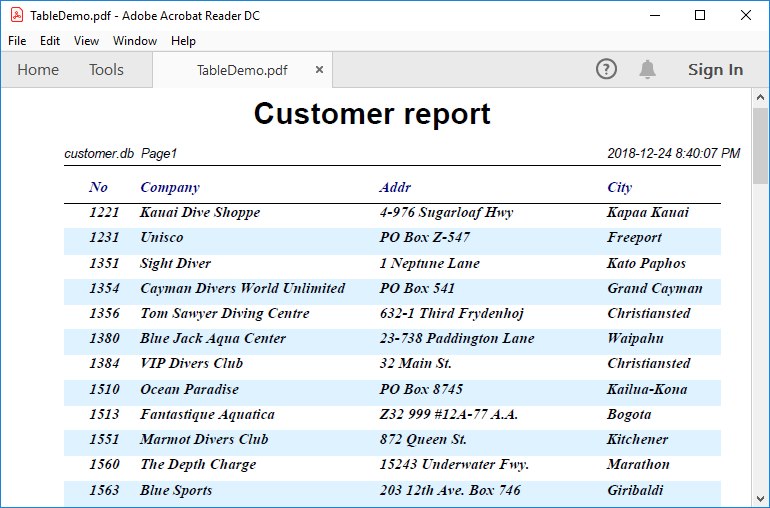
- Create new PDFs, add pages, draw text and vector graphics, register reusable Form XObjects, place images, and save to files or caller-owned streams.
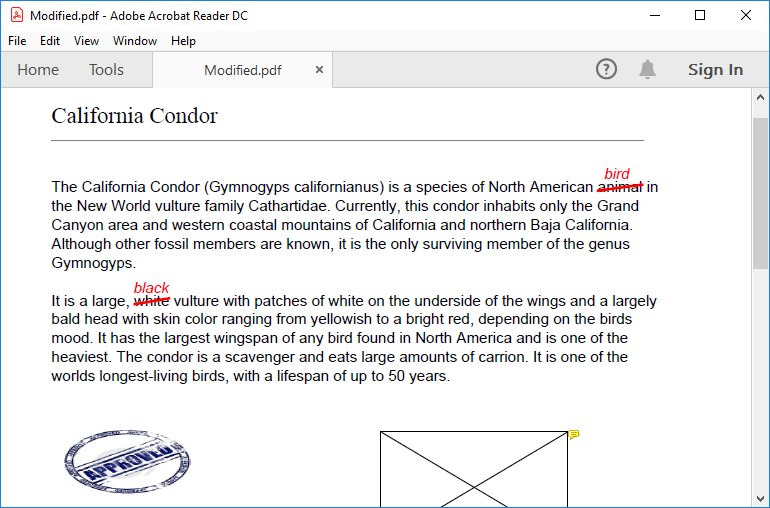
- Load existing PDFs, inspect page boxes, search bookmark destinations, copy pages, insert pages, extract pages, reorder pages, delete pages, merge documents, stamp or watermark content, and update document information.
- Add hyperlinks, named destinations, outlines, file attachments, comments, popups, highlight annotations, free-text annotations, redaction annotations, watermark annotations, page thumbnails, layers, page transitions, and viewer preferences.
- Create AcroForm fields, generated appearance streams, signature fields, multi-line and comb text fields, rich-text field values, XFA packet containers, form-field trigger wrappers, and multiple Unicode fonts in the AcroForm resource dictionary where the selected standard profile allows them.
- Inspect, update, rename, remove, or flatten fields in loaded AcroForm documents before saving an edited copy.
- Embed and subset TrueType, Type 1 PFB, OpenType-CFF, and CID-keyed CFF fonts for compact multilingual output, including CJK-heavy documents.
- Generate Unicode text, right-to-left text, vertical text, supplementary-plane characters such as emoji, Arabic / Persian / Urdu shaping, Latin standard ligatures, Devanagari reordering, and OpenType GSUB-based glyph output with matching
/CIDToGIDMap,/W, and/ToUnicodeintegration. - Import JPEG, bitmap, TIFF, JPEG2000, JBIG2, WMF, and EMF content, with zlib-ng Flate compression and libjpeg-turbo backed JPEG handling.
- Protect documents with passwords, AES-128, AES-256, PDF 2.0 AES-256 R6, public-key recipient encryption, and permission flags.
- Sign PDFs with in-process PFX / PKCS#12 support and PAdES B-B, B-T, B-LT, and B-LTA workflows including RFC 3161 timestamps and DSS / VRI dictionaries.
- Create text, JSON, and HTML preflight reports, apply preflight profiles and presets, aggregate batch results, embed report evidence in PDFs, compare reports, and run focused PDF/VT validation.
- Use optional PDF backends for FastReport, QuickReport, ReportBuilder, and DevExpress ExpressPrinting when existing report layouts should emit through HotPDF.
- Process very large PDFs at high speed with the Direct File API, which opens, copies, and rewrites documents directly on disk without loading the whole file into the object model. A 60,000-page / 883 MB document opens or copies in about 2-3 seconds, and re-saving it after a metadata or object change takes roughly 20 seconds.
- Encrypt and decrypt with AES-256 at hardware speed: where the CPU offers AES-NI, AES-256-CBC reaches about 442 MB/s for encryption and 832 MB/s for decryption (around 3× and 5.7× faster than the portable software path), whilst opening a large password-protected PDF now uses far less memory.
- Turn scans and photos into searchable PDFs with built-in OCR or pluggable Tesseract and RapidOCR adapters (DLL, CLI, or in-process ONNX), including scan orientation, skew, shadow, and perspective correction, multilingual model presets, and word-level confidence and geometry.
- Decode Code 128, EAN/UPC, QR, Data Matrix ECC 200, and PDF417 symbols from rendered pages and images, including multiple symbols per raster and perspective-distorted Data Matrix, and compare document or contract revisions with word-level insert, delete, replace, and move records and review artefacts.
- Drive headless document jobs through a JSON job schema and a C ABI — capabilities, rendering, Unicode text and form extraction, OCR layers, redaction, PFX signing, comparison, and atomic file publication — and run the portable core as native Linux code without an active desktop.
- Run dynamic XFA forms in process on Windows and Linux: QuickJS JavaScript and compiled FormCalc event scripts, SOM path resolution with wildcards, predicates, and relative occurrences, locale-aware date, time, and numeric picture clauses, a namespace-aware Data DOM with bidirectional bindings, and transactional rollback when a script fails. Native PDF page trees, repeated fields, choice lists, radio groups, checkboxes, push buttons, draws, and images can be created directly from XDP and saved runtime data.
- Fill rich-text form fields with typed Unicode style runs and genuine embedded regular, bold, italic, and bold-italic fonts, choose caller-supplied font families per grapheme, wrap with Unicode 17 line-breaking and grapheme rules, keep bidirectional paragraphs and paired brackets intact, and import or export styled FDF and XFDF into signed or encrypted documents.
- Apply signing policy end to end: signature seed values and certificate constraints, DocMDP certification with P1, P2, or P3 permissions, FieldMDP locks, legal attestations, named signature appearance profiles, embedded CRL and OCSP revocation evidence, RFC 3161 signature and standalone document timestamps with SHA-256, SHA-384, or SHA-512 imprints, and signatures on AES-encrypted documents that preserve the original revisions.
- Render demanding page content with the built-in renderer: CMYK and ICC transparency groups with every blend mode, function, axial, radial, Coons, tensor, and triangle mesh shadings, coloured and uncoloured tiling patterns, optional-content visibility, calibrated CalGray, CalRGB, and Lab colours, Separation and DeviceN tints, soft masks, 182 built-in legacy CMaps, CID-keyed CFF, and embedded Type 1 fonts.
Download the HotPDF Delphi Component DEMO package
2026-10-11 Version 2.968.0: HotPDF release notes. The latest release evaluates explicit rich-text colour scheme, reduced motion, transparency, data, contrast, forced-color, and scripting-availability preferences. Releases since 2.929.0 add a CSS cascade engine for rich-text fields — internal, linked, and imported style sheets, media queries, attribute, sibling, structural, and positional selectors, scoped namespaces, and cascaded letter and word spacing; extend XFDF and FDF interchange to eighteen mapped annotation types with stamp appearances, local and remote GoToR destinations, and exact no-selection versus empty-export semantics; render missing annotation appearances from original font programs, including Type1C, CIDFontType0C, bare Type1, bevelled and cloudy borders, and line captions; build field appearances from complete OpenType CFF and CFF2 variable fonts; manage transactional XFA form trees and live Data DOM collections from JavaScript and FormCalc; decode signed and unsigned JPEG 2000 components through 26 bits; apply automatic optional-content usage contexts; and reject all-zero X25519 / X448 shared secrets. Earlier releases create native XFA forms directly from XDP, including page trees, repeated fields, choice lists, radio groups, Boolean marks, push-button captions, draws, and images, and run the XFA JavaScript, FormCalc, Data DOM, and ICU locale runtime natively on Linux; add rich-text form fields with typed Unicode style runs, embedded four-style fonts, caller-supplied font fallback, Unicode 17 line breaking, bidirectional paragraphs, and GPOS mark attachment, with styled FDF and XFDF import and export through Windows file jobs and Linux JSON callbacks; extend signing with DocMDP P1 to P3 certification, named appearance profiles, standalone RFC 3161 document timestamps, SHA-384 and SHA-512 imprints, and authenticated Adobe revocation archival; render shadings, patch and triangle meshes, tiling patterns, optional content, dash arrays, CID-keyed CFF, and 182 built-in legacy CMaps, with Cairo output on Windows as well as Linux; and compare documents by text, structural graph, and rendered pixels, with annotated contract review PDFs.
Licensing and pricing
Pay with credit/debit cards, PayPal, AliPay, or wire transfer through 2Checkout / FastSpring -- every tier lists both checkouts, choose either. Every new HotPDF licence includes the full Object Pascal source code, one year of updates, and one year of email support.
| Licence | Developers | Price | Order |
|---|---|---|---|
| Single | 1 developer | $950 | Order |
| Small Business | Up to 10 developers | $1900 | Order |
| Medium Business | Up to 30 developers | $2850 | Order |
| Enterprise | All developers in one company and its subsidiaries within a single country | $5700 | Order |
| Corporate | All developers in one company and its subsidiaries worldwide | $11400 | Order |
Enterprise and Corporate source extras: HotPDF Enterprise and Corporate both include complete source code for dedicated tool-grade examples, currently PDF Preflight Pro and XFA & AcroForms Flattener Pro; source code for the internal testing projects is available on request.
Existing customer renewal: Renew update access at 50% of the full licence price; if your update service has been interrupted for more than 1 year, a full-price purchase is required instead. Open the HotPDF purchase and renewal page.
Standards, signing, and validation workflows
HotPDF supports standards-aware PDF generation workflows for PDF/A-1, PDF/A-2, PDF/A-3, PDF/X-1a, PDF/X-3, PDF/X-4, and PDF/UA-1. It also includes preflight and focused PDF/VT validation helpers for review and automation workflows. The component exposes profile-specific switches and guards so calls that would break the selected profile can fail early instead of silently writing a non-conformant PDF.
| Workflow | HotPDF support | Author responsibility |
|---|---|---|
| PDF/A-1, PDF/A-2, PDF/A-3 | PDFACompliance, XMP pdfaid metadata, OutputIntent support, font-embedding enforcement, JavaScript/encryption/annotation/profile guards, and PDF/A-2A / PDF/A-3A smoke outputs validated with veraPDF. | Choose the target level, provide real ICC OutputIntent data, set title/language, embed appropriate fonts, and avoid content outside the selected archival profile. |
| PDF/UA-1 | PDFUACompliance, Tagged PDF root, pdfuaid metadata, /Lang, DisplayDocTitle, structure elements, marked content, role mapping, ParentTree wiring, alternate text and ActualText helpers. | Build meaningful document structure, reading order, heading hierarchy, list/table semantics, and alternative descriptions for real content. |
| PDF/X-1a, PDF/X-3, PDF/X-4 | PDFXCompliance, OutputIntent support, prepress profile guards, and restrictions for interactive or non-print-safe features. | Provide print-appropriate colour management, page boxes, and production settings for the chosen prepress workflow. |
| PDF/VT validation | ValidatePDFVT checks XMP PDF/VT identification, metadata namespace, modification-date consistency, PDF/X base markers, OutputIntent, catalogue DPartRoot structure, loadable pages, and page-level DPart coverage. | Use it to audit incoming or produced files; authoring the full variable-data production intent remains the caller's responsibility. |
PDF/A Level A enables the Tagged PDF foundation required by the archival profile. It does not automatically advertise PDF/UA-1; HotPDF emits the PDF/UA identity only when PDFUACompliance is explicitly enabled.
Preflight APIs can produce text, JSON, and HTML reports, filter output through saved profiles or built-in presets, aggregate batch results, embed report evidence in a review copy, compare reports, and convert reports into a veraPDF-style structure for downstream tooling.
Additional feature coverage
- OpenType GSUB LookupType 1-8 support, script/language feature selection, Latin standard ligatures, Arabic / Persian / Urdu shaping, Devanagari reordering, and PUA synthetic codepoint emission for font-specific glyphs.
- XFA packet container support, AcroForm
/AAtrigger wrappers, multiple Unicode fonts in AcroForm/DR, and generated CID-font appearance streams. - Incremental update saving, multi-signature workflows, signature placeholders, in-process CMS SignedData generation, and long-term validation dictionaries.
- Loaded-document helpers for page-box inspection, bookmark destination lookup, AcroForm field inspection, field value updates, field renaming, field removal, and form flattening.
- Preflight profile load/save/validate/merge/diff helpers, batch aggregation, embedded report validation, XMP report embedding, focused PDF/VT validation, and conservative repair from preflight reports.
- PDF 1.3 through PDF 1.7 feature gates, selected PDF 2.0 encryption support, object streams, XRef streams, OutputIntents, transparency groups, soft masks, patterns, shadings, and prepress ExtGState controls.
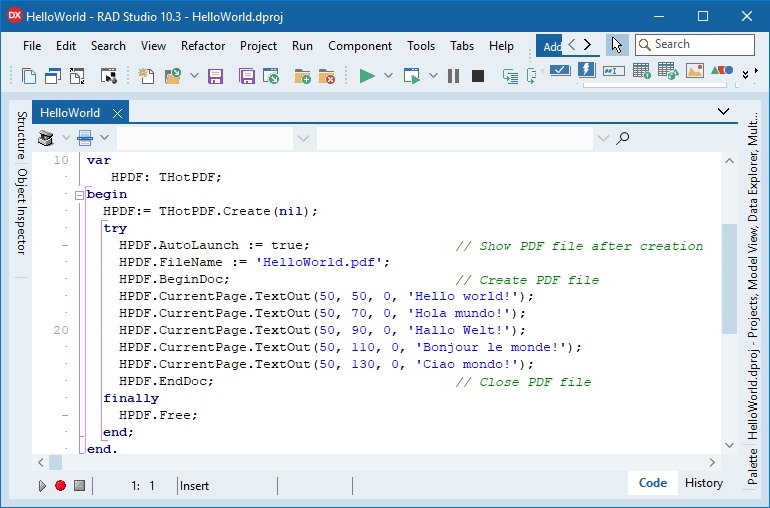
Quick Delphi example
program HelloHotPDF;

uses
  System.SysUtils,
  HPDFDoc;

var
  PDF: THotPDF;
begin
  PDF := THotPDF.Create(nil);
  try
    PDF.AutoLaunch := False;
    PDF.FileName := 'HelloHotPDF.pdf';
    PDF.Compression := cmFlateDecode;
    PDF.EnableFontSubsetting := True;
    PDF.BeginDoc;
    PDF.CurrentPage.SetFont('Arial', [], 18);
    PDF.CurrentPage.TextOut(50, 50, 0, 'Hello HotPDF');
    PDF.EndDoc;
  finally
    PDF.Free;
  end;
end.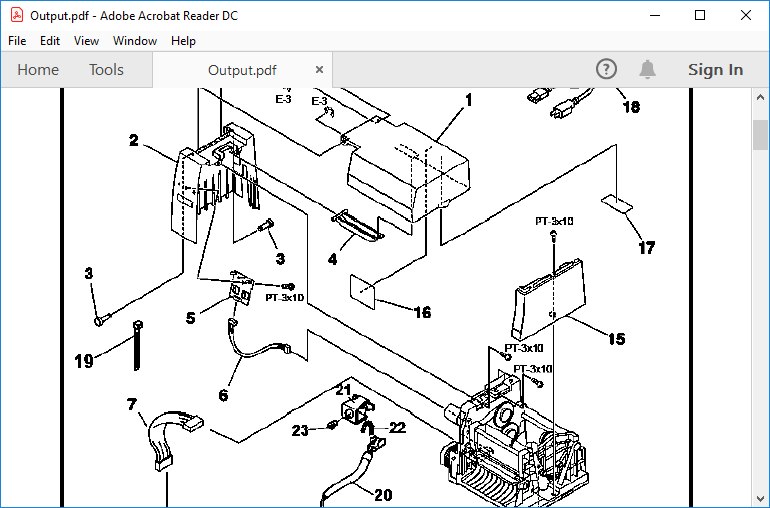
Download the HotPDF Delphi Component DEMO package
Supports RAD Studio XE5 through RAD Studio 13.1 Florence for Delphi and C++Builder (Win32, Win64, and Win64x workflows) and Free Pascal 3.2.2 / Lazarus (Win32, Win64)
When to choose HotPDF
- Choose HotPDF when your application creates or edits PDF documents and you would rather ship nothing alongside it: HotPDF carries its own rendering engine, image codecs, and font engine, so it compiles straight into your executable with no PDF runtime to redistribute or audit.
- Choose PDFium Delphi Component when the work is reading and reviewing rather than authoring: viewer architecture, accessible read-aloud, table extraction, semantic reflow to HTML, and standards validation. It renders through
pdfium.dll, which you redistribute with your application. - Choose PDF Library for Delphi when you need PKCS#11 hardware-token signing, EU trust-list validation, or DOCX export, or when non-Delphi code has to call in through DLL, ActiveX, or Dylib.
Comparing the whole family? See the PDF developer libraries overview for a side-by-side of PDFium Delphi Component, losLab PDF Library, and HotPDF Delphi Component.
Frequently asked questions
Which Delphi and C++Builder versions are supported?
HotPDF supports RAD Studio XE5 through RAD Studio 13.1 Florence for both Delphi and C++Builder, covering Win32, Win64, and Win64x application targets. The whole library also builds with Free Pascal 3.2.2 and Lazarus for Win32 and Win64, with native Flate compression and AES encryption.
Is source code included?
Commercial licences include Object Pascal source code for integration, review, and long-term maintenance.
Are runtime royalties required?
Licensed applications can be deployed royalty-free without per-document or per-end-user runtime fees.
How do I evaluate the product?
Download the demo package and review the online documentation before purchase.
What does a new licence include?
A new licence includes source code, one year of updates, and one year of email support.
How does renewal work?
Existing customers can renew update access at the published renewal price.
Where is the API documentation?
The documentation is available under the localised HotPDF Delphi Component documentation link on this page.
What does a HotPDF licence include, and how does renewal work?
A new licence ($950 Single, $1900 Small Business (up to 10 developers), $2850 Medium Business (up to 30 developers), $5700 Enterprise (one company, one country), $11400 Corporate (one company, worldwide)) includes full source code, one year of updates, and one year of email support. Existing customers renew update access at 50% of the full price.
Discover more from Delphi PDF Component & Spreadsheet Development
Subscribe to product updates
Subscribe to get the latest updates sent to your email address.